
I bought the Bedsure weighted heating pad on a Wednesday night after a track session that left my upper back and neck feeling like a clenched fist. I had skimmed three reviews, seen that it had 4.2 stars and over three thousand ratings, and figured anything that specific about neck-and-shoulder coverage was worth trying at this price. It arrived Friday. I have now used it roughly 150 times over the past several months. And I want to tell you the part that none of those three reviews mentioned: the stuff you figure out session by session, not star by star.
I am Marcus, 38 years old, and I run competitively at the amateur level. I log about 45 miles a week when training is on track, which means my neck and traps get hammered. Not from lifting, mostly from road running posture and long tempo efforts where my shoulders creep up. The Bedsure is one of several recovery tools I use. This is the Bedsure from that angle: a runner's honest take after heavy use, not a first-impression unboxing.
The Quick Verdict
Better heat delivery than you would expect at this price, but the 15-minute auto-shutoff, the side-exit cord, and the marketing language around 'weighted' all need some reality-checking before you buy.
Amazon Check Today's Price →If tight neck and traps are slowing down your recovery between sessions, heat plus mild vibration is worth trying before you spend more on a massage gun.
The Bedsure is one of the lowest-cost ways to add electric heat therapy to your routine. Check what it is selling for right now.
Amazon Check Today's Price on Amazon →What the Listing Gets Right (And Where It Oversells)
The listing photos show someone looking serene in a dimly lit room with the pad draped perfectly around their neck and the cord somehow invisible. That is not what using this thing looks like. The cord exits from one short end of the pad, runs about five feet to a wall plug, and it is stiff. If the outlet is on your left and you want to turn your head right, you feel the tug. If you are trying to recline in a chair, the cord angles awkwardly and you either lay it across your chest or let it pull the pad off-center. It is a workable inconvenience, but it is a daily one.
The listing also emphasizes the 'weighted' design in the product name. I want to be specific here because 'weighted' triggers a mental image of something like a weighted blanket, which uses glass beads for genuine proprioceptive pressure. The Bedsure is not that. It is heavier than a standard flat heating pad, which is true, and that extra weight does help it stay in place on your shoulders rather than sliding off. But if you are buying it expecting the kind of calming pressure you get from a weighted blanket, you will be surprised. The weight is a stability feature, not a therapeutic compression feature. That distinction matters.
What the listing gets right: the heat. Three levels, and medium is genuinely warm within two to three minutes. That is not guaranteed on cheap heating pads. Some discount pads barely reach lukewarm on medium. The Bedsure delivers real warmth quickly, and that is the core job. For that, the listing is honest.

The 15-Minute Auto-Shutoff: What Nobody Explains
The product mentions auto-shutoff. What it does not tell you is that the shutoff happens at exactly 15 minutes, every cycle, with no setting to extend it. You press the button to start a session. Fifteen minutes later it shuts off silently, no warning beep, no indicator that you are approaching the cutoff. If you are doing something else during the session, which is the whole point of a passive recovery tool, you may not notice for a few minutes. Then you realize your pad has been off and cold for three minutes and you have to restart the cycle.
I have gotten used to it. My workaround is to set a phone timer for 14 minutes so I am ready to restart before it cuts off. That is a genuinely odd thing to have to do for a mid-priced product designed for passive recovery. Other pads in this price range offer 30-minute or 60-minute sessions. If uninterrupted sessions matter to you, this is the single most important limitation to know before buying. It is not dealbreaking for everyone. It was a recurring irritation for me over 150 sessions.
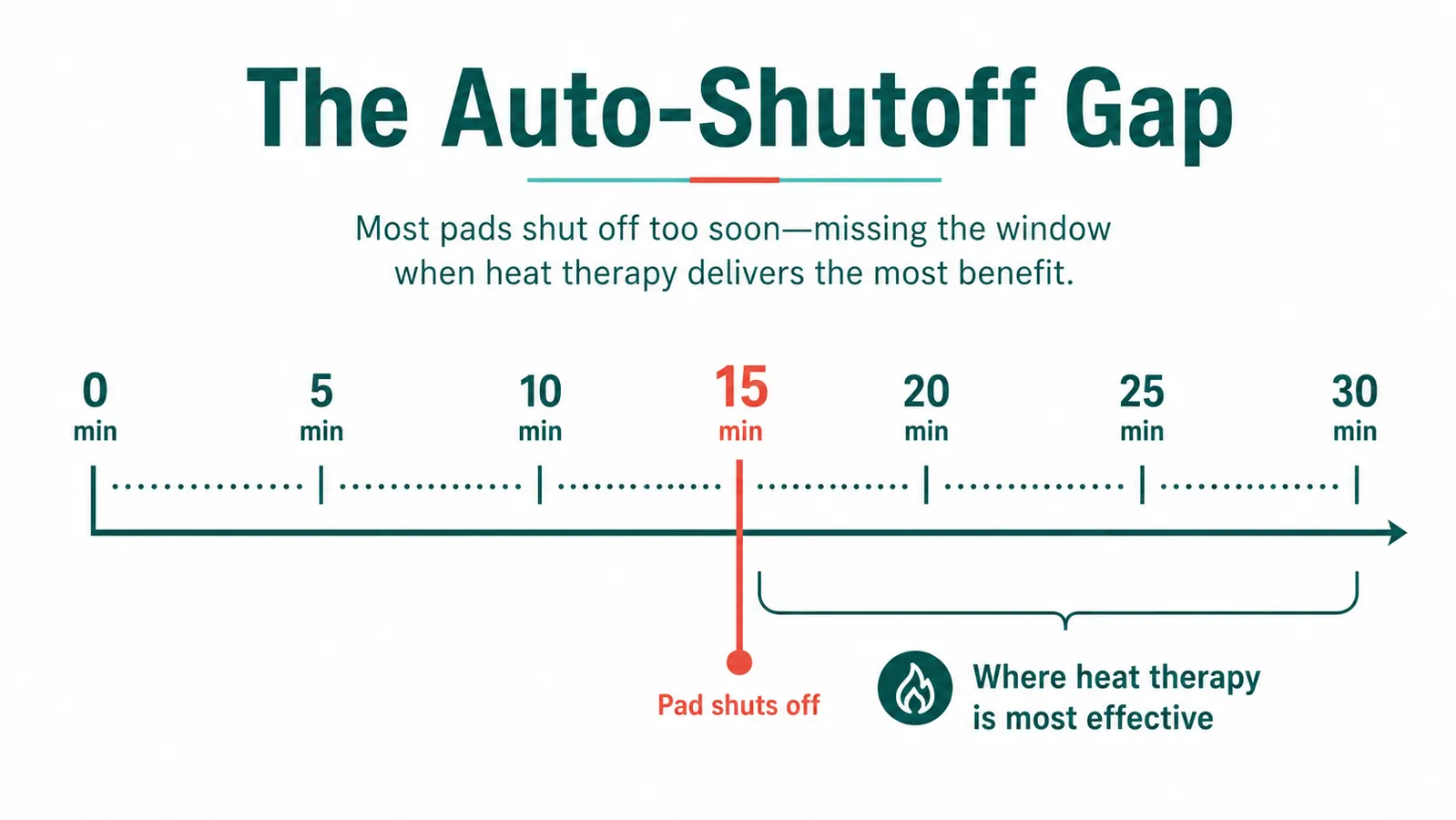
The rationale for the 15-minute cutoff is safety: the pad prevents overheating and potential skin irritation from prolonged direct contact at high temperatures. That is a legitimate engineering reason. But 15 minutes is a conservative threshold, and it makes the pad feel engineered around liability more than around the actual user experience. Most physical therapists suggest heat application windows of 15 to 20 minutes as a starting point, meaning the pad shuts off right at the floor of what is considered useful.
The Three Vibration Settings: What They Actually Feel Like
The listing shows three vibration speeds. Here is what they actually feel like in practice. Low vibration is a subtle oscillation that you feel more as a gentle buzz against the skin than a massage. It makes the heat feel more active and less static, and it does something modest but real to the surface tissue. I use it. Medium vibration gets more noticeable, still manageable, but starts to produce an audible hum that is present enough to be slightly distracting if you are trying to read or be on a call. High vibration is where the pad loses me. It vibrates enough that the pad shifts slightly on your shoulders, requires you to press it back down with your hands, and produces a buzzy sensation that I would describe as agitating rather than therapeutic.
So in practice, I use low vibration about 80 percent of the time and no vibration the other 20 percent. The upper two vibration settings have not earned any consistent use in 150 sessions. The vibration is a useful bonus at the low setting. At high, it is genuinely counterproductive for the use case the pad is designed for.
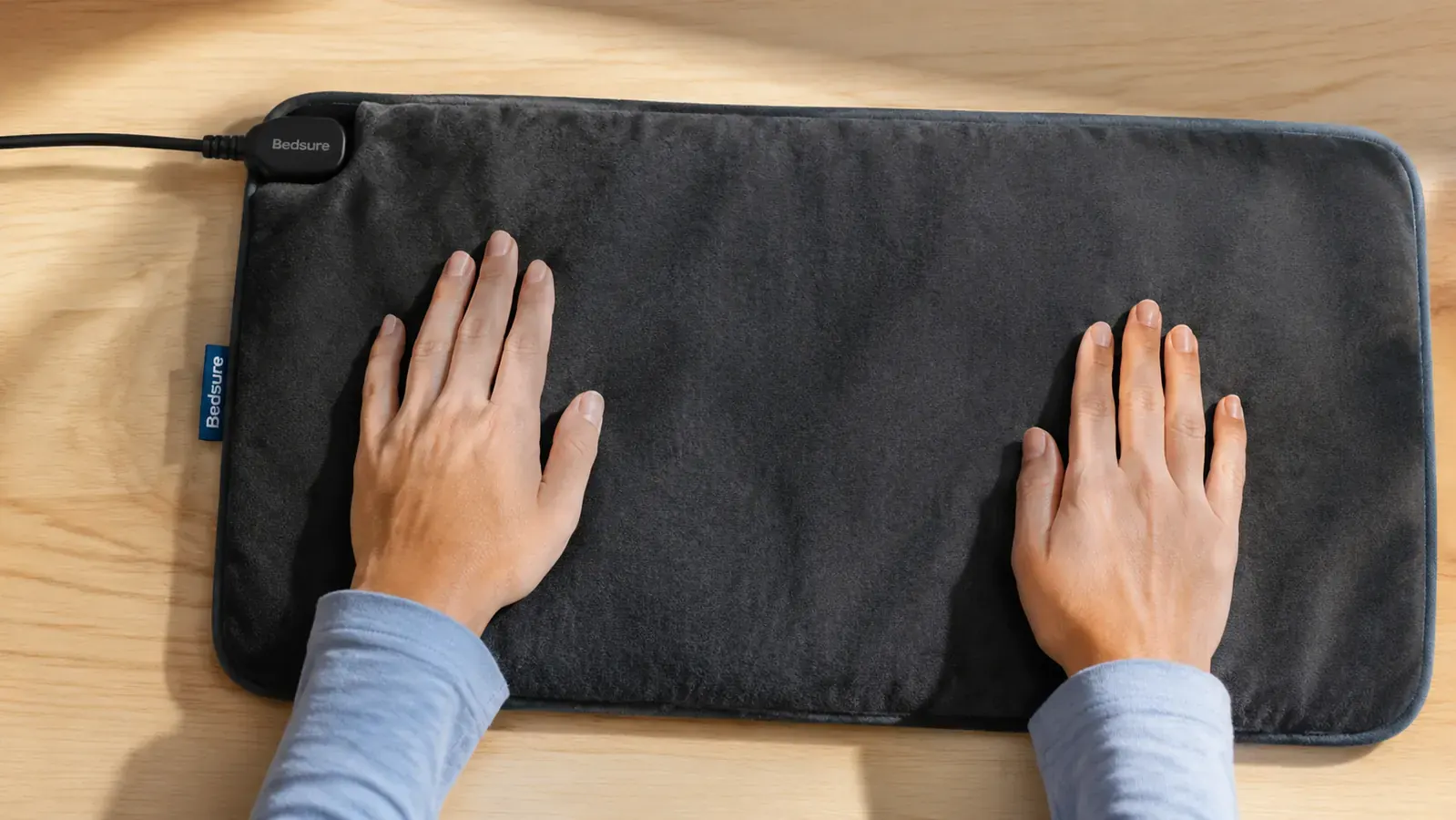
After 150 sessions, my honest summary: the heat works, the low vibration adds something, and basically everything else is a workaround you learn to live with or decide you cannot.
Fabric, Cleaning, and Long-Term Surface Wear
The cover is removable and washable, which I did not realize until session 20 when I actually read the care instructions. That matters because if you use it post-run, the fabric will absorb sweat and eventually develop the smell any wearable recovery tool picks up with regular use. Removing the outer cover and washing it is easy, maybe a two-minute job, and it comes out clean. I wash mine every three to four weeks. If you skip that step and use this pad regularly through heavy training, you will notice it after a month or so.
The fabric itself is soft and has held up through regular use and repeated washing without pilling. The seams at the corners, which I expected to show stress first, are still clean. The heating element inside is not removable, so you are always hand-washing or delicate-cycle washing the cover only, never putting the full assembly in a machine. That process is fast enough that it does not feel like a burden, but it is worth knowing the care routine requires the extra step.
One observation about long-term surface changes: by around session 80, the inner fill material had shifted enough that the pad no longer lies perfectly symmetrical. One side sits slightly fuller than the other. It does not affect heat delivery in any measurable way, but the pad no longer looks new. If you care about aesthetics, you will notice. If you care about function, it is a non-issue.
What the 4.2 Rating Actually Signals
A 4.2 rating across more than 3,000 reviews tells you something specific about the buyer population. It means this pad has a meaningful number of disappointed buyers, not just a handful. The critical reviews cluster around three themes: the cord placement and inflexibility, the 15-minute auto-shutoff, and the fit on broader frames. None of those complaints are wrong. After 150 sessions I agree with all three of them. The question is whether they are dealbreakers for you specifically.
The positive reviews cluster around two things: the heat works and the price makes it an easy buy. Those are also accurate. What I have found is that buyers who use this pad for desk-bound recovery during working hours, with access to an outlet on one consistent side and a tolerance for restarting sessions, rate it highly. Buyers who want something they can move around the house freely, recline with, or forget about for 30 minutes while it runs, tend to be the frustrated ones. The 4.2 rating is not a product-quality signal as much as it is a use-case-fit signal.
The Things That Surprised Me After Heavy Use
A few things I did not expect. First: the controller buttons are better than I anticipated. They have a clear tactile click and still register cleanly at session 150. No mushy button feel, no double-registration. That kind of input quality is not guaranteed on budget accessories and the Bedsure held up.
Second surprise: the heat-and-low-vibration combination is noticeably more effective at releasing neck tension than heat alone. I had expected the vibration to be a gimmick feature, something added to justify a slightly higher price point. For the low setting, at least, I was wrong. The combination of warmth and mild oscillation does something to the muscle tissue in the upper neck area that a plain compress does not replicate. I am not going to speculate on the mechanism. I can just tell you it felt different and that difference has been consistent.
Third surprise, and this one is genuinely unexpected: I have found the Bedsure useful for post-run upper back work, not just post-lifting. Runners who hold tension in the neck and thoracic area during long tempo efforts will recognize the kind of stiffness that settles in one to two hours after a hard run. Heat therapy applied to the upper trap and base of skull during that window, before the stiffness fully sets, seems to shorten the duration of that tightness. Whether that is the pad specifically or heat therapy generally, I cannot say with certainty. But it is a consistent pattern across about 60 post-run sessions.
How It Fits Into a Real Recovery Stack
I use the Bedsure as one piece of a bigger routine. It goes on after I stretch and before I eat breakfast, typically a 15-minute session on medium heat with low vibration. It is a passive tool: I sit with it on while I am doing something else, not a dedicated recovery activity in its own right. That is the correct framing for it. Expecting it to replace deeper tissue work would be a mistake. A foam roller handles my thoracic spine. A massage gun gets into my calves after long runs. The Bedsure is specifically for the neck and upper trap region where those two tools are either awkward or useless.
If you are looking at this and wondering whether to try it as your first heat therapy tool, the answer for most active adults is yes, with the caveats described here. The honest morning-routine story behind how it fits into a daily schedule is covered in the Bedsure heating pad morning routine piece, which walks through exactly how to slot 15 minutes of heat therapy into a real training day without adding friction. And if you are still deciding between this pad and the Sunbeam alternatives, the Bedsure vs Sunbeam comparison goes line by line through the specs that actually matter for muscle recovery, not the marketing language.
What I Liked
- Heat output on medium and high is genuinely useful, reaching therapeutic warmth within two to three minutes
- Low vibration setting adds real value to sessions; makes heat feel more active and less static
- Removable, washable cover makes long-term hygiene manageable with light maintenance
- Controller buttons are durable and still register cleanly after 150 sessions
- Heavier than standard flat pads, which keeps it positioned on sloped shoulders better
- Price point makes the cost-per-session math extremely favorable even over extended use
Where It Falls Short
- 15-minute auto-shutoff interrupts every session with no option to extend; requires a workaround
- Cord exits from one short end and is stiff, limiting positioning options during use
- Medium and high vibration settings are more distracting than therapeutic for most use cases
- 'Weighted' in the product name suggests pressure-based therapy; the weight is primarily a stability feature
- Heat coverage narrows toward the ends; does not reach lateral shoulders on broad-framed users
- Inner fill shifts over heavy use; pad loses its flat symmetry by session 80 or so
Who This Is For
This pad suits you if you want a low-cost, low-maintenance way to add electric heat therapy to post-training neck and shoulder recovery, you have access to an outlet in a consistent spot, and the 15-minute session length aligns with your schedule. Runners, cyclists, and anyone whose sport pulls the upper traps will get real use out of it. People who work at a desk and want to decompress the neck region after hours of screen time will also find this fits naturally. Average to narrow shoulders will get better fit and coverage than larger frames.
Who Should Skip It
If you need long uninterrupted sessions, want to recline or move around while using a heating pad, or have a large frame where lateral shoulder coverage matters, this pad will frustrate you. If you are looking for genuine weighted pressure therapy similar to a weighted blanket, the Bedsure is not that product. If the combination of vibration noise and cord management sounds like daily friction you do not want to add to your routine, a simpler flat electric heating pad with a longer timer would serve you better. And if you are hoping for anything close to the depth of release a massage gun or percussion tool provides, heat therapy in general is the wrong category, not just this pad.
150 sessions in, the heat still works and the low vibration still earns its keep. If the cord and the 15-minute shutoff are things you can route around, this is a solid buy at this price.
Check current pricing and stock before deciding. It moves around.
Amazon Check Today's Price on Amazon →